Taiwan’s 100-Year Sports Figures Chronicle, Volume 16
This article is a translation of a research piece by authors Wei Kuo and Jin-Fang Kuo on Master Su Mo. The original article can be found using the link below.
Su Mo -The Lucky Master
About the source
The source places the Su Mo Master Memorial Hall in the National Martial Arts Cultural Park on Haiqing Road in Sihu Township, Yunlin County, and presents Su Mo as the third-generation successor of Shunwutang and a figure associated with Southern Boxing. The translated article combines field visits, interviews, published sources and archival material.
I. Introduction
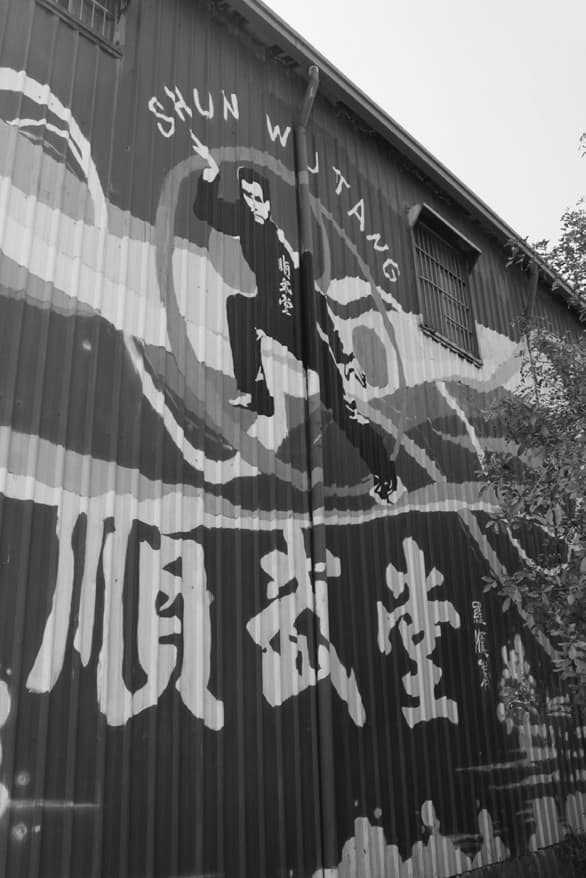
The “Su Mo Master Memorial Hall” is located in the National Martial Arts Cultural Park on Haiqing Road in Sihu Township, Yunlin County. Walking along the Santiaolun seawall leads to Haiqing Temple (originally Haiqing Temple Senluo Hall). Inside are three inscriptions expressing the spirit of Shunwutang: “Following Heaven and responding to people; equally civil and martial” (upper text); “Following Heaven, cultivating righteous qi, nourishing essence and gathering spirit” (right text); and “The way of the martial sage: cultivate both skill and virtue” (left text).
The red-brick memorial hall displays artifacts related to Su Mo and Shunwutang, including weapons, battle formations, training photographs and festival performances. It was established by Su Mo’s disciples and local residents to remember him for protecting the community through martial arts. Today it is one of Yunlin County’s community cultural-preservation and creative-living attractions, and a place where visitors can explore local traditional culture. Su Mo devoted his life to the community and passed his skills to later generations; his history continues to be remembered.
Su Mo was a native of Sihu Township, born April 5, 1911, and died December 6, 1990. He was the third-generation successor of Shunwutang and was known as the “Fu Master” of Southern Boxing. Early Taiwanese martial arts were dominated by Southern Boxing traditions from southern Fujian. After the Nationalist government moved to Taiwan, Northern styles and internal martial arts also appeared and developed. Yunlin once had many martial arts halls, including Zhenxing Society, Wuye Hall, Qinxi Hall, Shunwutang and Deyi Hall.
Shunwutang was established in Fujian in the mid-Qing period. At that time, local militias were organized to resist disturbances by the Taiping forces, and martial arts, weapons and battle formations were taught as a means of maintaining local security. Shunwutang was established in Taiwan in the late Qing period: Lu Rong was the first Taiwan successor, Wu Ju the second, and Su Mo the third. Its curriculum centered on the Eighteen Arhats of Southern Shaolin, together with Taizu Boxing, White Crane Boxing, qinna (seizing techniques) and wrestling. It emphasized coordinated use of hands and feet and combined throwing, striking and seizing. There were forty-four boxing routines, taught progressively from basic to advanced, integrating upper and lower body, internal and external aspects, and hardness with softness.
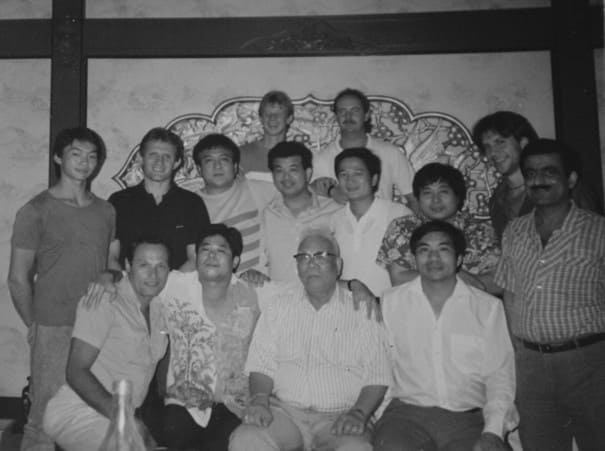
The weapons and battle formations of Shunwutang included long, short, paired, flexible and concealed weapons; battle formations included Qian-gou and Songjiang formations; hanging techniques, hardening techniques, lion dancing and lion-slaying were also practiced. The principal deities worshipped were Bodhidharma, the White Crane Immortal, Jiutian Xuannü and Taizu of Yue.
Sihu Township lies at a remote coastal corner. Residents made their living in close relationship with the sea, temples were numerous, and banditry was once widespread. To protect homes and support temple festivals, local people invited skilled martial-arts masters to establish schools, teach boxing and organize Golden Lion and Songjiang formations. Southern Boxing was practical and suited farmers: combat emphasized close-range exchanges, courage, power and technique.
At age ten Su Mo began studying under Wu Ju and built a solid foundation. As a youth he could wield a Spring-Autumn Broadsword weighing dozens of jin while standing on a square table, jumping as though on level ground. His reputation grew, and he later taught many students, stimulating local martial-arts development.
Conflicts often occurred when different martial-arts halls appeared in public formation contests, but when Su Mo was present the situation usually became peaceful. He was therefore recognized as a “Fu General” and called the “Fu Master of Southern Boxing.” He studied Taizu and Luohan Boxing, battle formations and medicine, and became especially skilled with double sabers and monkey boxing.
At eighteen he established his own school and expanded widely. Besides Yunlin, he taught in Changhua, Pingtung, Taitung, Hualien and Luodong, and later had students in Japan, Singapore, South Africa, Portugal, the United Kingdom, Sweden, Eswatini, Namibia, Poland, Spain, Greece and Lesotho.
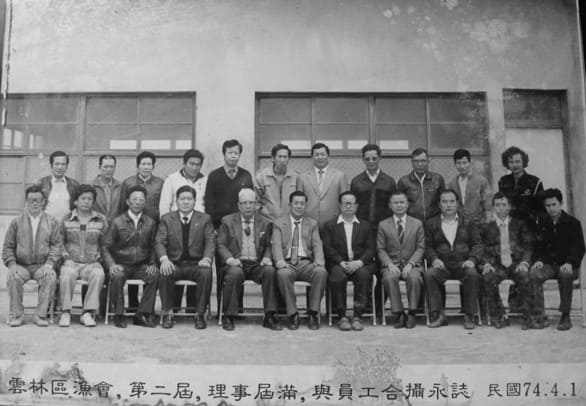
Students and disciples of Su Mo eventually appeared in many countries. After turning eighteen he served as a local neighborhood headman; after 1949 he also served three terms as village head, for a total of 28 years. He served on the Sihu District Fishermen’s Association and, after administrative reorganization, on the Yunlin District Fishermen’s Association.
Weapons were classified into long, short, paired, flexible and concealed types, each with prescribed methods and practical paired-training applications.
“Gua technique,” also called leaning, hanging-limb, lifting or blocking technique, is a distinctive Fujian Southern Boxing method used to train, test and compare skill.
“Gang technique,” also called plate-limb training, develops hardness of the arms and methods of attack and defense through paired drills and footwork.
Lion-slaying contains a symbolic “overthrow the Qing and restore the Ming” meaning. Two people perform the lion dance while another carries weapons and fights the lion; a red coloring is used to symbolize success.
Bibliographic and interview sources cited by the authors, including works on Sihu, Su Mo Memorial Hall and the Shunwutang tradition.
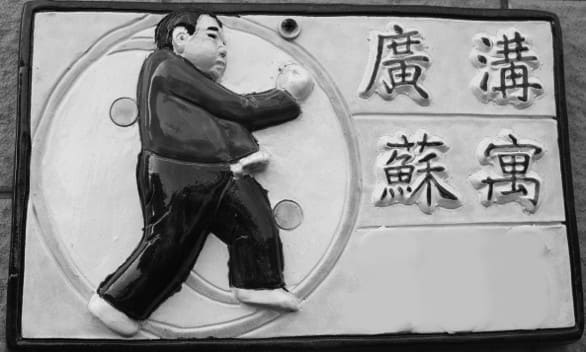
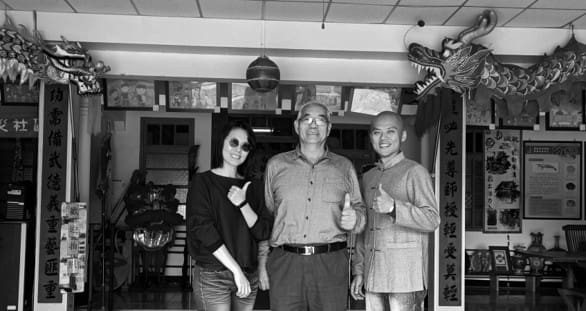
On February 5, 2021, the two authors visited Guangou Village in Sihu Township to meet Master Su Jinmiao, Su Mo’s fourth son. They were struck by the scale and care shown in the village’s installations, artifacts, statues and martial-arts training center. Each household had a distinctive martial-arts motif on its exterior address plaque. At Master Su Jinmiao’s home they saw a special Shunwutang logo made by disciples from South Africa and France, as well as bottles and weapon-shaped key rings, reflecting the disciples” respect for Shunwutang.
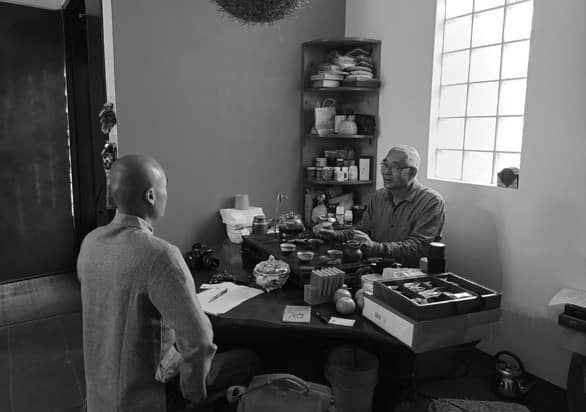
Across three interviews and field visits totaling about nine hours, the authors explored the cultural hall and its martial-arts and physical-training stations, weapons and symbols. It felt like entering a famous martial-arts school from a wuxia novel. After personally learning the hanging technique, they developed even greater respect for the depth of the art, confirmed by the “Shunwutang Genealogy” displayed on the wall.
II. Life and Achievements
1. Becoming a Disciple and Learning the Art
In 1921, local people in Guangou Village hired Wu Ju, the second-generation Shunwutang successor, to teach Taizu Luohan Boxing, Little Horse Road, Lotus Sweep and Reverse Triangle Step. This laid the foundation for the local transmission of Shunwutang martial arts. Training also strengthened village solidarity, and residents joined martial formations and temple-festival activities. If villagers were bullied by outsiders, young people would collectively go out to seek justice.
Although many youths practiced martial arts, Su Mo’s father, Su Wei, initially forbade him from participating because he was mischievous and allowed only Su Mo’s elder brother Su Tiansong to train.
At age ten, Su Mo secretly watched Wu Ju teach his students and then practiced alone in secluded places. Wu Ju eventually discovered him and tested his skills, finding him no less capable than his own students. With local figure Huang Song, Wu Ju persuaded Su Wei to allow Su Mo to study martial arts.
Su Mo progressed rapidly. At fifteen, Wu Ju recognized him as his successor and, with his father’s permission, took him as an assistant. Su Mo carried his teacher’s leather bag every day and distinguished himself among many fellow disciples, mastering the transmitted art.
Su Jinhuang recalled that his father once slept on a large rope tied tightly to a tree branch, lying with his hands behind him and his legs gripping the rope. Through this strict self-discipline he cultivated himself day after day, developing remarkable awareness. He expressed the ideal in a couplet: “As qi rises and falls, intention and spirit remain; martial skill is tempered to protect the nation.”
The authors interviewed Master Su Jinmiao three times, on Feb. 5, July 16 and Aug. 9, 2021, in Guangou Village. Sources on the village martial-arts halls and Su Mo’s childhood. Interview and published sources concerning Su Mo’s training and the recollections of his children and disciples.
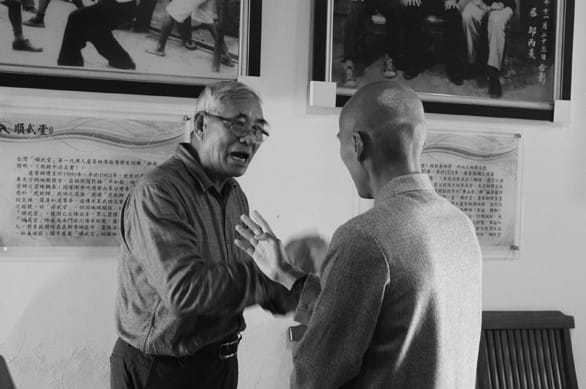
Su Mo often said: “Every technique has a counter; a hundred techniques have a hundred solutions.” Every movement in Shunwutang boxing had a practical combat application. Each step could contain one or several techniques, and every attacking technique had a corresponding method of countering it: horizontal attacks were met with straight solutions, straight attacks with horizontal solutions, combined attacks were separated, and double attacks were answered singly.
Because of Su Mo’s deep study of boxing systems and routines, he became known as a master of Southern Boxing. His disciples carried the art forward to later generations. Among the many students were Shi Jinshu, Cai Shuiyou, Wu Wenzan, Xu Shufa, Lin Di, Lin Youfang, Wu Jin, Zhou Jinyong, Wu Qingzhi, Wu Yuanli, Wang Chunhai, Otaka Tadahiko, Su Jinhuang, Su Jinzhi, Su Nengzhen, Su Jinmiao, Su Nengying, Su Jinjie, Su Jinbang, Su Jinzhen, Su Biling and others.
Wang Chunhai’s Zhang’er hammer, Ke Fen’s Spring-Autumn broadsword, the lion dancing of Wu Xianzhang and Wu Sanyuan, and Su Jinhuang’s Luohan Boxing were especially outstanding.
2. Mastery of the Art and Extensive Teaching
After leaving his teacher, Su Mo practiced diligently every day. In 1955, Cai Shan, a representative of the Boge Liao community, invited him to establish a training hall there so local youths could learn martial arts. He taught Cai Shuiyou, Cai Wanbao, Cai Yinfu and Cai Fenglu. In 1957 he accepted another group of students, including Wu Xianzhang, Wu Sanyuan, Wu Qingzhi, Wu Chang, Zheng Qingkao, Chen Zhengqi and Wu Qingkao.
In 1958, local leaders in Santiaolun decided the area needed a lion formation and recruited young people. They invited Su Mo from Guangou Village to establish a school and teach the traditional Shunwutang boxing and formation drills. Because of strict training, it became the largest Golden Lion formation on the coast at the time.
That same year Su Mo also taught at Lindong Village and Lincuoliao, teaching routines such as Luohan Boxing, Black Dragon Plays in Water, Reverse Lion Throw, Ground Golden Hook Scissors, Single Battle, Child Crossing the Pass and Removing Armor.
Su Jinhuang recalled that every village had at least one formation. Martial-arts halls went out with drums and gongs to perform in temple courtyards; villages competed through formations and performances, and larger audiences were considered a sign of strength.
Su Jinhuang recalled that every village had at least one formation. In the past they all used martial-arts halls; they went out with drums and gongs, and once they reached a temple courtyard they performed the formation. Villages competed so that their celebrations would be lively and no village would lose face. Formations could fill an entire temple courtyard, and several formations might compete at once. They arranged their formations, surrounded the space and performed boxing; the larger the audience, the more impressive the performance was.
Sources on Su Mo’s teaching principles and practical applications. Source on the Shunwutang succession system and the traditional discipleship ceremony, including vows to the ancestral master, respect for the teacher, teacher’s fees and material support. Source on the responsibility for preserving martial arts in Guangou Village. “Training hall” here means a hall where only boxing is practiced without organizing a lion formation; other categories distinguish halls with lion formations, weapons and full martial formations. Sources on Su Mo’s teaching in local villages and interviews with Su Jinhuang.
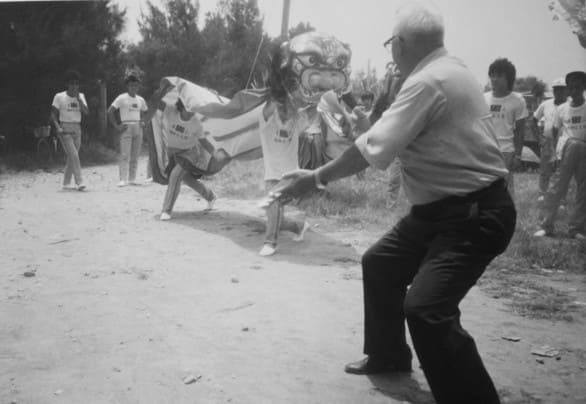
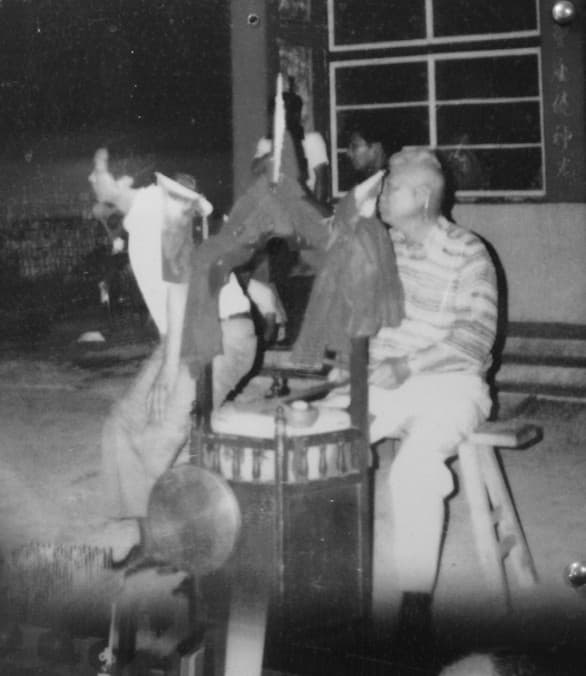
A remarkable story is associated with the Golden Lion of the martial formation. The lion used by Shunwutang had to be taken to a stream with clean running water, where a ritual of chanting and “opening the light and dotting the eyes” was performed. After this ceremony the lion head was regarded as a “spirit beast” and had to be treated with respect; it could not simply be discarded or stepped over. Once, Wu Ju prepared a new lion head to replace an old, damaged one and unknowingly threw the old head into a rubbish pile. That night, the lion was said to come and bite Wu Ju’s foot. The next day the discarded head was retrieved, its spirit was ritually withdrawn, and it was burned.
Around 1961, because people in Xizailun were frequently bullied, local leaders invited a martial-arts master to teach there. Su Mo established a training hall and taught Wu Yong, Wu Jin, Wu Zhicai and other youths. In 1966, Sanfangzi wanted a Golden Lion formation for pilgrimage activities and invited Su Mo to teach there. He subsequently taught martial arts and formations throughout Sihu, Taixi and Kouhu townships. At the peak, ten or twenty halls operated simultaneously, so Su Mo sometimes sent disciples to teach in his place.
Su Jinhuang recalled traveling with his father during the day, riding bicycles to villages and martial-arts halls. His father taught every movement while Su Jinhuang assisted, and sometimes learned new routines himself. Su Jinmiao explained that his father was often away because a martial-arts teacher without students had no income; therefore Su Mo taught widely and worked very hard.
Because Su Mo had served as a local headman during the Japanese period, villagers respected him for personally resolving problems. Through the cohesion of the martial-arts school he trained villagers both as skilled martial artists and as people capable of catching thieves. If a household shouted “Thief!”, Su Mo would beat a drum to summon the whole village. Su Jinmiao recalled that in Guangou, where households raised chickens, ducks, pigs and sheep, theft was common and his father was always the first to chase a thief.
In an era when people believed “we must protect our own homes,” villagers sought Su Mo whenever disputes needed to be settled. Su Jinmiao described this as a spirit of loyalty and righteousness: protecting villagers” property even at personal risk.
As described above, whenever nearby villages wanted to organize a Golden Lion formation or teach boxing, Su Mo was the first person considered. In addition to Yunlin, he established halls in Hualien, Tanqian, Fengyuan, Wanhua, Luodong and Hengchun, and even in Tokyo, Japan’twenty halls in total. While visiting his son in South Africa he personally instructed students, and overseas students also traveled long distances to study with him.
His skills were also passed directly to his children. His eldest son, Su Jinhuang, began accompanying his grand-teacher Wu Ju at about fifteen or sixteen and became Su Mo’s capable assistant after several years of training.
3. Teaching His Children Martial Arts
Su Mo had eight sons’Jinhuang, Jinzhi, Nengzhen, Jinmiao, Nengying, Jinjie, Jinbang and Jinzhen’and three daughters’Biyu, Biying and Biling. Eight sons and daughter Biling practiced martial arts. The children woke at about five each morning, trained in the family courtyard, and were taught by the older children while Su Mo trained outdoors. After returning, he personally instructed them before breakfast and school.
Sources concerning the Golden Lion ritual and Su Mo’s teaching in Xizailun and Sanfangzi. Explanation of the drum, gong and cymbal signals used in Shunwutang formations, including assembly, marching, concealment, positioning, encirclement, rest, rapid advance, deceptive formation changes, battle and victory signals. Sources on Su Mo’s teaching network and family discipleship. Interviews and reports concerning the children’s training and village security.
Su Jinmiao recalled that after school and dinner, their father would have them fill a basin with water and strike each other’s bodies with their hands until the skin became red, stimulating the capillaries and conditioning the flesh. On holidays they trained in boxing, weapons, concealed weapons, qinna and sparring. On Saturday afternoons they also had to collect fish, cut grass and gather branches and leaves for cooking because there was no gas. They raised pigs, ducks and geese, gathered pigweed to feed them, and fished when the family could not afford meat.
Su Jinhuang said that after striking the body, their father would prepare medicinal powder, mix it in a large bowl and have each person drink a bowlful; this was how their internal and external training was developed.
When teaching boxing, Su Mo often explained its principles. For “hard attack and direct advance,” he compared a falling tree: move quickly toward the treetop, not toward the trunk end. For “hardness and softness together,” the shoulders and arms should be soft like rope while the fist should be hard like a spiked ball. When it contacts an opponent, the body’s power should be released like a sudden flood. Skill depends on the mind, and endurance, attacking power and sustained power are all necessary.
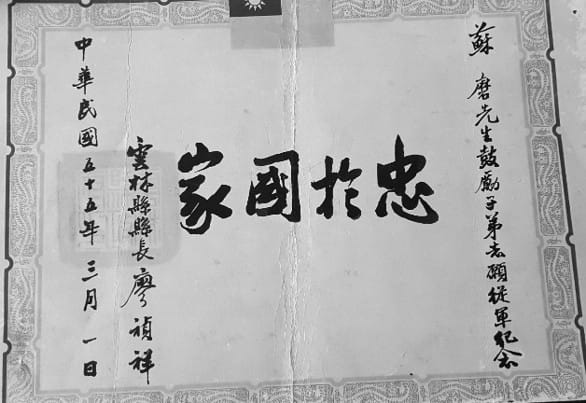
Under Su Mo’s close daily guidance, the children developed different strengths. Su Jinhuang was said to have exceptionally heavy punches, powerful enough to deform a can; Su Jinzhi was especially fast in his punches and footwork; Su Nengzhen’s boxing was especially elegant; Su Jinmiao combined the strengths of different schools, later studying Northern Boxing and Yang-style Taijiquan; and Su Jinzhen was known for agile movement and footwork. Su Mo also encouraged his children to volunteer for military service and serve the country.
4. Overseas Touring Performances
In 1972, when Thai Prime Minister Thanom visited, the Su family’s martial-arts troupe was invited to perform at a state banquet at Zhongshan Building on Yangmingshan. The troupe later represented the country on many overseas visits to comfort overseas Chinese communities in the United States, Canada, Venezuela, Guatemala, Malaysia, Hong Kong, Thailand, Singapore, the Philippines, South Korea and Japan.
In 1975 Su Nengzhen was sent by the Ministry of Education on a tour of the United States and later visited overseas Chinese communities in Britain, Germany and France. In 1976 Su Jinzhi, Su Jinmiao and Su Biling performed in the United States; later they toured Southeast Asia with the Li Tanghua performance troupe. In Malaysia they witnessed a robbery and helped subdue the robbers, becoming local heroes in newspaper reports. The group also represented the Republic of China at a Pacific Travel Association meeting in Korea and performed Chinese kung fu.
In 1977 Su Nengzhen visited Europe and Su Jinmiao Southeast Asia. In 1979 Su Jinmiao and his wife took a disciple to Japan to enter an NHK competition for unusual talents, performing Chinese kung fu and qigong and winning the championship. These activities show how the Su family’s students rode the global kung-fu boom and how Shunwutang’s art expanded with it, opening opportunities to teach in South Africa.
Interviews and sources concerning family training, martial-arts principles and the children’s strengths. Sources concerning the Su family’s overseas tours and performances.
III. Major Achievements and Contributions
1. Cultivating Martial Virtue in Disciples
Su Mo’s senior fellow disciple Huang Song said that the school emphasized the two characters “benevolence” and “righteousness.” Su Jinmiao regarded martial virtue as a condition of being a martial artist, a moral outlook and sentiment for practitioners, and also an attitude toward life and moral cultivation.
Shunwutang’s teachings include: 1. Upright conduct: high character, an open heart, honesty, dignity, and neither arrogance nor servility. 2. Humility and forbearance: openness, no pride, moderation and courtesy. 3. Cultivation of benevolence, righteousness, wisdom, trust and courage. 4. Respect for teachers and the Way: honoring elders, learning humbly and observing the etiquette of disciples. 5. Team spirit: respecting fellow practitioners and never forming factions for private gain. 6. Professional social responsibility: extending consideration to others, serving the public, contributing one’s knowledge and carrying the tradition forward.
Su Mo also taught these principles: a teacher transmits the Way, teaches skills and resolves doubts; once a teacher, always a father. Training is like cooking’first use strong heat, then gentle heat. Martial arts require single-minded concentration. Practice must not be neglected: when the spirit arrives, qi arrives; when qi arrives, strength becomes firm. Train calmly, never carelessly or restlessly. Progress layer by layer, like unwinding silk and peeling bamboo shoots. Settle the spirit within; respond calmly when events arrive and let the mind become still when they pass. Speech should be careful and conduct upright. Martial arts should retain the character of one’s own school; blindly copying others without independent spirit is a great mistake. Training requires stillness: when strength is settled there is calm, and calm gives rise to life; true skill is the ability to remain calm both in stillness and movement. Seek a quiet mind; when the mind is quiet, the spirit is clear, and when the spirit is clear, qi is harmonized.
These principles of mental cultivation and martial virtue were to be developed through actual practice, internalized as core values, formed into moral habits and ways of conduct, and expressed through action. Therefore, Shunwutang’s basic requirements emphasized etiquette and patience, as well as ethics between senior and junior disciples and between teachers and students.
2. Continuing Traditional Culture and Developing Local Creative Industries
Before 1949, Taiwanese folk martial arts were commonly distinguished by hall names such as Shunwutang, Qinxi Hall, Zhenxing Society and Tongyi Hall. Martial arts developed early in Sihu, with different schools introduced and almost every village having a martial-arts hall and formation. Skilled people were invited to neighboring townships to teach and organize teams, creating distinctive village traditions.
To preserve traditional cultural assets connected to local life, Su Mo’s children actively promoted their continuation when holding important local positions. After Su Jinzhi became township head, he promoted community development and the idea of “one township, one””.” The Sihu Township Office used Shunwutang as a core organization to develop martial arts as a local specialty, organizing community-development and martial-arts inheritance programs, summer camps and training camps.
Since 2000, with support from the Yunlin County Government, martial arts were promoted throughout the county’s junior-high and elementary schools, with teacher training, seed-coach courses and martial-arts assessments. In 2002, funding from the Council for Cultural Affairs was obtained to purchase Golden Lion props, weapons, uniforms and equipment and establish the Sihu Township Martial Arts Combat Team, coached by Su Jinzhi. Members included workers in employment programs, township-office employees, home-care workers for older people, Santiaolun beach staff and members of the public.
On August 20, 2002, Paraguayan President González visited Taiwan. A state banquet was held at Janfusun Prince Hotel in Gukeng, Yunlin, where Shunwutang was invited to perform weapon sparring, iron-throat skills, qigong bottle breaking, routines and “iron-fist” demonstrations. On December 27, President Chen Shui-bian visited Putian Temple in Sihu and Anxi Temple in Taixi and watched performances by Shunwutang and the Martial Arts Combat Team. The Council for Cultural Affairs described the team as an outstanding folk group.
In 2004 the team performed at the Presidential Office Plaza. Later that year Shunwutang presented a Golden Lion formation at the Yunlin County Council Chairperson’s Cup. In 2005, at the Douliu Folk Culture Festival, members demonstrated feats including crushing glass with bare feet, driving an eight-inch nail through a wooden board with a fist, qigong bottle breaking and tiger-head guillotine techniques.
Sources and interviews on martial virtue, teaching principles and Shunwutang ethics. Sources on the history of Taiwanese folk martial arts and local cultural-development programs.
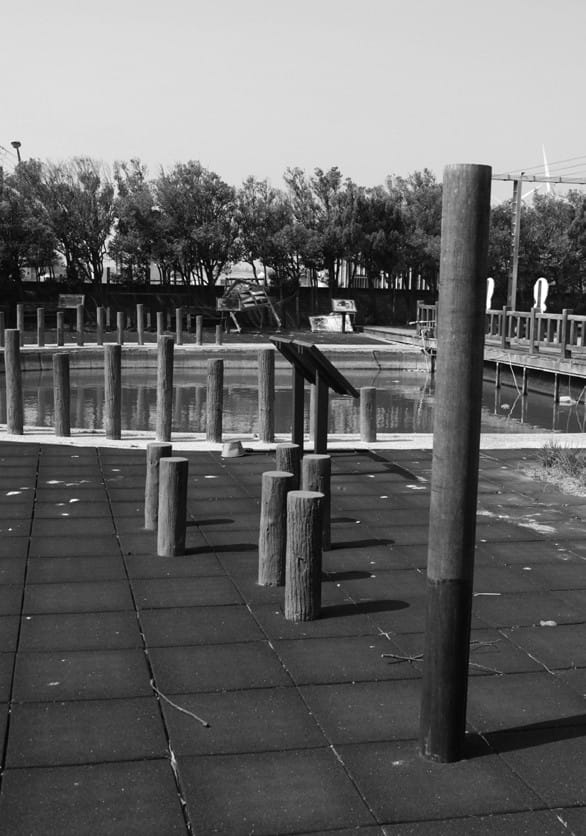
The Guangou community also combined martial-arts heritage with local industry by creating the “Kung Fu Shrimp” brand and designing a “martial-arts training ground for drying shrimp.” Wooden posts were installed over an artificial pond, resembling ancient water-walking skills, attracting visitors and linking martial-arts culture with local specialty industries. Residents transformed abandoned land into community parks and incorporated plum-blossom posts, wooden dummies and explanations of weapons. They also held martial-arts cultural festivals and designed martial-arts challenge games.
3. Transmission of Martial Arts at Home and Abroad
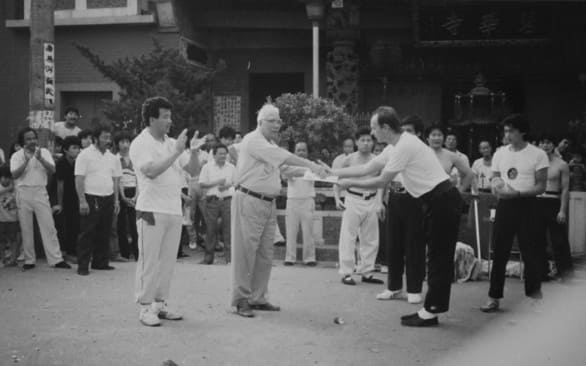
In 1974 Japanese sixth-dan karate master Otaka Tadahiko came to Taiwan to investigate the relationship between karate and Fujian Southern Boxing. He consulted with Su Mo, sparred with him and studied Southern Luohan Boxing, accompanied by five people including a student photographer, an illustrator and a translator. They learned Luohan Boxing, qinna, White Crane Boxing and Taizu Boxing.
Singaporean Five Ancestors Boxing successor Zhong Yishun later learned of Su Mo’s skills and came to Taiwan to study technique and training methods. Su Jinmiao explained that Five Ancestors Boxing includes Taizu, Luohan, Dazun, Monkey Boxing and White Crane; because Shunwutang teaches Taizu and Luohan, the systems are technically close and easy to exchange through demonstration and discussion.
Examples of teacher-training and martial-arts assessment sessions held from 2002 to 2005, with sources on Yunlin’s school martial-arts program. Sources on the Sihu Martial Arts Combat Team, performances, the “Kung Fu Village” development and the local cultural industry. Interviews with Master Su Jinmiao concerning Otaka Tadahiko and Zhong Yishun.
Examples include seed-teacher training held Apr. 17–19, 2002; martial-arts assessments Nov. 20”Dec. 10, 2002; regional seed-teacher courses in 2003; seed-teacher training Apr. 11–15, 2003; martial-arts assessment Apr. 1–15, 2004; seed-teacher training Aug. 9–13, 2004; martial-arts assessment Apr. 25”May 5, 2005; and seed-teacher training July 4–8, 2005. Sources: Su Jinzhi oral history compiled by Wu Renhe and Liao Suzhen, “Devoting a Lifetime to the Transmission of Martial Arts.”
Wu Xiantong, The Sihu Township Martial Arts Combat Association Golden Lion Formation That Won National Fame, in The Hometown of Martial Arts, 2004, p. 142.
Liang Zhenkun and Hou Shulun, “State Banquet Delicacies”” United Daily News, Aug. 20, 2002,
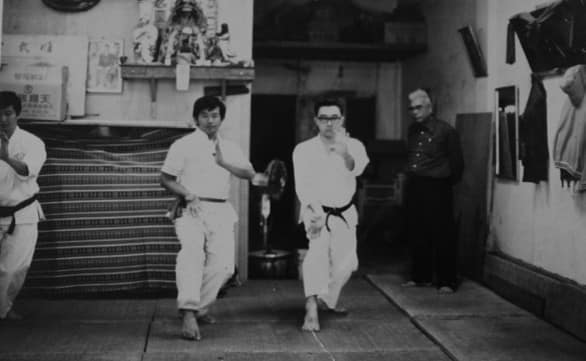
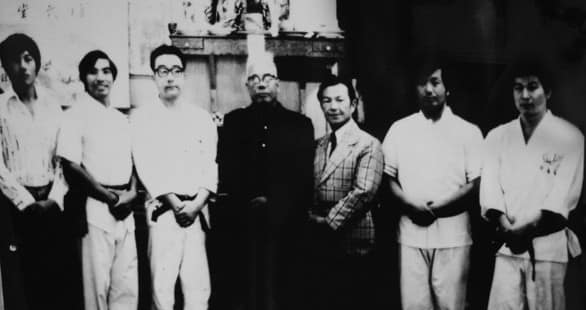
Interviews with Master Su Jinmiao and sources on the spread of Shunwutang in South Africa and other countries. Newspaper sources concerning French, South African and German students visiting Taiwan to study martial arts.
The following section describes the international development of Su Jinmiao, fourth-generation successor of Shunwutang.
Su Jinmiao is the fourth-generation successor of Shunwutang. From childhood he followed his father and brothers in diligent martial-arts training and acquired considerable skill. While at university he opened a hall and taught students to earn tuition. In 1983 he was recruited to the Chinese Cultural Center in Johannesburg, South Africa, mainly teaching the Chinese community, and later taught at a Chinese school in Port Elizabeth for ten years. His students expanded from overseas Chinese to local people, reaching more than 3,000, and he became known as “Master Su.”
In 1987 Su Mo traveled to South Africa to observe his son teaching. During a Republic of China National Day event at the Chinese Cultural Center, Su Mo also provided free medical treatment to local people. Hu Weizhen, Consul General of the Republic of China in Johannesburg, invited him to a dinner, where he demonstrated hard qigong. According to Su Jinmiao, the 76-year-old Su Mo invited people to punch his abdomen; each punch was said to rebound from his body. The audience applauded enthusiastically. After Su Mo’s death, one South African branch reportedly enshrined his portrait and burned incense daily.
In addition to the headquarters in Johannesburg, twenty-four branch halls were established in other South African cities and a national martial-arts association was organized. France also had eight branch halls with nearly one thousand students. The tradition expanded to Portugal, Britain, Sweden, Eswatini, Namibia, Poland, Spain, Greece and Lesotho. Students from overseas continued to travel to Taiwan each year to study, with students from South Africa and France making more than thirty study visits in total.
In August 2001 French youth Cedric Mallet came to Taiwan specifically to study Luohan Boxing with Su Jinmiao. In May 2002 six South African disciples came to Taiwan to become students of Su Jinmiao and trained with students from Feisha Junior High School in Sihu. One South African disciple said he admired the ethical character of Chinese culture and Chinese kung fu and admired Su Jinmiao’s martial arts, so he had traveled a great distance to study.
In 2004, nineteen South African students attended the Ninth World Cup Martial Arts Championship and several disciples placed in the top three. In 2005 Su Jinmiao’s senior South African disciple Morgan Hansen and three friends came to Taiwan to improve their skills. In 2006 thirteen South African disciples came to study and joined local martial-arts camps and exchanges. German youths also visited Feisha Junior High School. In 2007 three South African disciples came for grading and the World Cup, while four French grand-disciples came to Taiwan to experience Chinese traditional culture and consult Su Jinmiao on martial-arts routines.
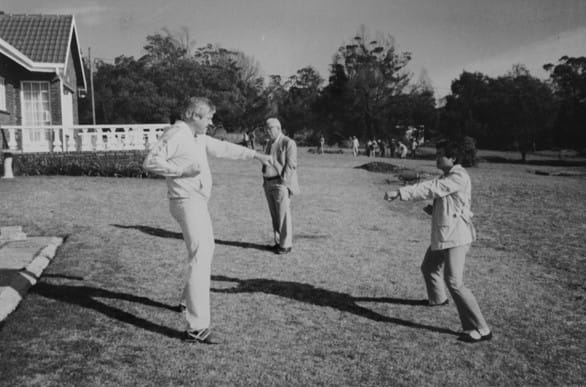
In March 2011, seventeen students from South Africa and France came to Taiwan for ten days of training and to experience local folk activities. In 2018, South African students invited Su Jinmiao and his student Yang Gaoteng to a farm in Durban for about a week of full-day teaching and training. The participating students each had their own martial-arts halls in South Africa and came for intensive training after hearing that their teacher or grand-teacher would visit.
In 2019 a group of thirty South African students flew and transferred for more than ten hours to Taiwan simply to meet the “Master Su” they had heard about. Some were third-, fourth- or even fifth-generation students. Although the airfare alone was burdensome, they economized so they could receive Master Su’s professional instruction, practical guidance and assessment. Su Jinmiao rented a tour bus to take them to the Guangou Village school. The building had two floors: the first contained a martial-arts platform, drums, gongs and weapons, with male and female dormitories; the second was a training center with martial-arts mats.
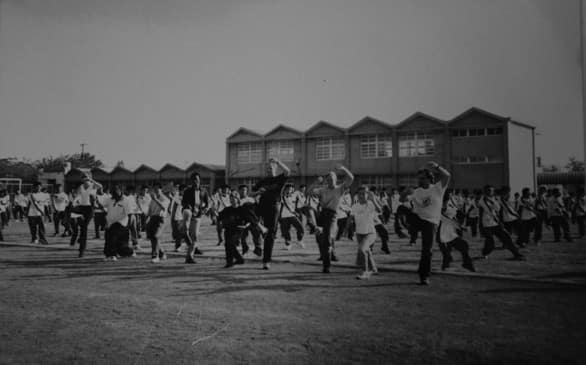
After Su Jinmiao returned to Taiwan in 1993, he established a martial-arts hall and training center in Guangou Village. He personally taught every Saturday and Sunday, focusing on competitive martial-arts routines with traditional martial arts as support. During winter and summer vacations he organized camps, taught outstanding students free of charge, and led teams to competitions across Taiwan. He also actively developed martial-arts education in schools, including Beigang Senior High School, Tuku Junior High School, Xiaolun Elementary School, Jianhua Elementary School, Shangde Elementary School, Lincuo Elementary School, Hongren Elementary School and Mingde Elementary School, among more than seventy schools. In 2001 he voluntarily introduced martial-arts teaching at Sihu Junior High School, replacing morning exercises with traditional martial arts to build physical fitness and promote the martial spirit.
In 1996 Feisha Junior High School principal Yin Zaitian appointed Su Jinmiao as parent-association chair and promoted martial arts at the school. In 2000 Yunlin education officials saw the school’s students perform well and decided to promote martial arts throughout the county.
After surveying 187 junior-high and elementary schools, the Yunlin County Education Bureau selected five areas’Chinese martial arts, taekwondo, Taijiquan, aerobic boxing and martial arts’for promotion among students. From 2003 the Yunlin County Martial Arts Committee held spring and autumn county chairperson’s cup championships each year. Competitors were divided into elementary, junior-high and senior-high groups, and events expanded to competitive routines (Southern Boxing, Long Boxing and Taijiquan), traditional Northern Boxing, traditional Southern Boxing, internal martial arts, long weapons, short weapons, miscellaneous weapons and weapon sparring.
Schools in Sihu repeatedly achieved strong results, with some competitors regarded as promising young talents. The article attributes these results to the support of the Yunlin County Government, the Yunlin County Martial Arts Committee and Sihu Township, together with the dedicated cultivation of Su Jinmiao.
Newspaper source on the 2011 visit by South African and French students. Interviews with Master Su Jinmiao concerning the 2018 and 2019 training visits. Sources on the development of school martial-arts education, competitions and the contribution of Sihu to Yunlin’s martial-arts movement.
IV. Conclusion
In 1990, Su Mo developed severe shortness of breath one night and was taken by his son Jinhuang to a private clinic in Taixi. The doctor recognized myocardial infarction, gave him a sublingual tablet and instructed him to rest at the clinic until morning for further examination. Su Mo’s condition improved slightly, but he secretly returned home that night. The next morning, neighbors reported seeing him walking around the street. The following night the breathing difficulty returned. After he was treated at a local hospital in Huwei, Jinhuang called an ambulance and took him directly to Taipei Veterans General Hospital. Examination found that one and a half coronary arteries were blocked. He was admitted to intensive care, but he felt he was not seriously ill and wanted to go home; this emotional state contributed to deterioration, and he eventually died at Taipei Veterans General Hospital.
Looking across Su Mo’s life, he studied Taizu Luohan Boxing, battle formations and medicine, devoted himself to the development of Shunwutang and expanded martial arts from village communities to locations throughout Taiwan and overseas. Students and later-generation disciples appeared in Japan, Singapore, South Africa, Portugal, Britain, Sweden, Eswatini, Namibia, Poland, Spain, Greece and Lesotho. Taiwanese martial arts successfully crossed racial, linguistic and cultural barriers’described by the authors as a successful form of “martial-arts diplomacy.”
Su Mo emphasized martial virtue among his disciples. His children also practiced what they learned through their father’s words and example and devoted themselves to society. Their careers included public service and professions related to martial arts and medicine. Su Jinhuang served as chairperson of the Yunlin County Council; Su Jinzhi served as head of Sihu Township; Su Nengzhen opened a Chinese-medicine clinic; Su Jinmiao became a martial-arts teacher and held positions in Yunlin’s investment-promotion and sports organizations and as president of the Chinese Martial Arts Association in South Africa; Su Nengying served as a section chief in Taipei County Government and worked in real estate; Su Biling served as village head of Guangou Village; Su Jinjie operated a Chinese-medicine clinic, hosted a radio program and chaired the Chinese Radio Program Association; Su Jinbang operated a Chinese-medicine clinic and served on a traditional-medicine association; and Su Jinzhen became general manager of the National Agricultural Cooperative Federation, chair of the Yunlin Health Association and head of the Shunwutang Kung Fu Stunt Troupe.
Through their efforts, the three strands of Su Mo’s life’s work’cultivating martial virtue, continuing traditional culture and local industries, and transmitting martial arts at home and abroad’continued to take root. Today Guangou Martial Arts Village is a source of pride for Guangou Village; Shunwutang is one of Yunlin’s major martial-arts centers; and its reputation at home and abroad helped create interest in kung fu and encouraged overseas visitors to Taiwan for study and cultural exchange.
Su Jinzhi oral history, compiled by Wu Renhe, “Development of Martial Arts in Sihu Township,” See Su Mo Memorial Hall.
References
1911 “ Born April 5 in Sihu Township, Yunlin County.
1921 Became a student of Wu Ju.
1926 Became Wu Ju’s assistant and mastered his teacher’s transmitted art.
1929 Established his own martial-arts hall and began teaching. Served as local headman.
1955 Established a training hall in Boge Liao and taught Cai Shuiyou, Cai Wanbao, Cai Yinfu and Cai Fengyuan.
1957 Taught Wu Xianzhang, Wu Sanyuan, Wu Qingzhi, Wu Chang, Zheng Qingkao, Chen Zhengqi and Wu Qingkao.
1958 Established a hall in Santiaolun; also taught in Lindong Village and Lin Cuoliao.
1961 Established a training hall in Xizailun and taught Wu Yong, Wu Jin and Wu Zhicai.
1966 Taught at the Sanfangzi training hall.
1987 Traveled to South Africa to observe his son Su Jinmiao teaching.
1990 Died on December 4.
- Books Wu Xiantong, Sihu People and Their Splendor. Sihu Township Office, 2006. Wu Xiantong, Sihu Sets Sail. Yunlin County Government, 2005. Wu Xiantong, The Sihu Township Martial Arts Combat Association Golden Lion Formation That Won National Fame. In The Hometown of Martial Arts. Sihu Township Office, 2004. Su Jinzhi, oral history, compiled by Wu Renhe, “Development of Martial Arts in Sihu Township.” In Sihu Township Gazetteer. 2006. Su Jinzhi, oral history, compiled by Wu Renhe, “Introduction to the Martial-Arts Halls of Each Village.” In The Hometown of Martial Arts. 2004. Su Jinmiao, “Shunwutang: The Birthplace of Taiwanese Traditional Martial Arts.” In The Hometown of Martial Arts. 2017. Su Jinmiao, The Heart’s Direction, the Way’s Destination: A Record of Shunwutang Martial-Arts Transmission in Taiwan. Yunlin County Government, 2005.
- Journals Liang Yufang, “The Origins and Development of Zhenxing Society’s Zhanghua Group Golden Eagle Boxing.” Journal of Body Culture 1 (2005): 341–353. Chen Sanlang, Jiang Yiting and Zou Yifen, “Exploring the History and Future Prospects of Xiluo Qinxi Hall Martial Arts.” Yunlin Literature 55 (2013): 65–101.
III. Newspapers and Periodicals Wang Zhihong, “Foreigners Make Their Move” Children’s Big Dolls.” United Daily News, 2007.07.05, C1. Wang Chuanming, “Six South Africans Learn Martial Arts from Su Jinmiao.” United Daily News, 2002.05.11, p. 1418. Wang Chuanming, “Students” Martial-Arts Performance Wins Presidential Praise.” United Daily News, 2002.12.28, p. 18. Wang Chuanming, “Su Mo Memorial Hall: Inheriting Martial Arts and Displaying Sihu’s Martial-Arts History and Artifacts.” United Daily News, 2002.09.13, p. 20. Wu Shuling, “Junior-High and Elementary Schools Promote Martial Arts: Five Areas Selected.” United Daily News, 2002.03.16, p. 1418. Wu Shuling, “Children Who Learn Martial Arts from Su Jinmiao Will Not Go Bad.” United Daily News, 2002.03.16, p. 1418.
III. Newspapers and Periodicals “ continued
Shen Juanjuan, Lin Zhenping and Zhuang Yazhu, “Martial-Arts Camp: Su Jinmiao Leads South African Disciples in Exchange.” United Daily News, 2006.07.04, C2. Jiang Yijing, “We Are One Family.” United Daily News, 2011.03.23, B1. Duan Hongyu, “Douliu Folk Culture Festival Welcomes Mazu”” United Daily News, 2005.05.01, C2. Miao Junping, “Sihu Junior High Changes Morning Exercises to Martial Arts; Su Jinmiao Invited to Teach Taijiquan.” United Daily News, 2001.10.20, p. 1418. Miao Junping, “Su Jinmiao: Kung Fu Fame Spreads Abroad.” United Daily News, 2001.08.14, p. 1815. Gao Youzhi, “Xiluo Has Zhenxing Society; Sihu Has Shunwutang.” China Times, 2011.06.26, A13. Gao Youzhi, “Rise with the Rooster, Train with the Drum: The Whole Village Joins In.” China Times, 2011.06.26, A13. Gao Youzhi, “Taiwan’s Version of Pig-Cage Village: The Disappearance and Rebirth of a Kung Fu Village.” China Times, 2011.06.26, A13. Liang Zhenkun, “Dragon-Phoenix Lion, Hakka Lion, Taiwan Lion: Competition at the Council Chairperson’s Cup”” United Daily News, 2004.11.23, C1. Liang Zhenkun and Hou Shulun, “State Banquet Delicacies”” United Daily News, 2002.08.20, p. 19. Zhuang Yazhu, “Su Jinmiao, Head of the Martial Arts Committee: South African Disciples Visit Taiwan Every Year.” United Daily News, 2007.04.17, C1. Zhuang Yazhu, “German Youth Learn Martial Arts at Feisha Junior High.” United Daily News, 2006.08.02, C2. Zhuang Yazhu, “Su Jinmiao’s South African Disciples Visit Taiwan for Guidance.” United Daily News, 2006.07.11, C2.
Guo Liangjie, “Helping Others and Doing Good: Huang Song’s Health and Longevity”” China Times, 1996.04.23, p. 16. Lu Yongming, “Chinese Martial Arts Spread in South Africa: Su Jinmiao Planted the Seeds 22 Years Ago; South Africa Now Has 24 Martial-Arts Halls and More Than 3,000 Students.” United Daily News, 2005.03.23, C2. Lu Yongming, “Soft-Spoken Su Biling: A Martial-Arts Expert”” United Daily News, 2005.09.15, C2.
- Online Sources Liao Suzhen, “Devoting a Lifetime to the Transmission of Martial Arts.” Epoch Times, 2013.09.14. Lai Shuhui, “The Real-Life Version of Kung Fu in Yunlin! The Inheritance Site of Shaolin Luohan Boxing’the Legend of Sihu Kung Fu Village.” Sanlih News, 2015.03.31.
- Interview Transcripts Master Su Jinmiao, interview, Guangou Village, Sihu Township, Feb. 5, 2021; interviewers Wei Kuo and Jin-Fang Kuo. Master Su Jinmiao, interview, July 16, 2021; interviewers Wei Kuo and Jin-Fang Kuo. Former Yunlin County Council Chair Su Jinhuang, interview, Aug. 9, 2021; interviewers Wei Kuo and Jin-Fang Kuo. Master Su Jinmiao, interview, Aug. 9, 2021; interviewers Wei Kuo and Jin-Fang Kuo.
VI. Other Materials
Martial Arts Cultural Hall “ Overview of the Distribution of Martial Arts Development in Sihu Township. Martial Arts Cultural Hall “ Martial Arts in Yunlin County Junior-High and Elementary Schools. Martial Arts Cultural Hall “ Shunwutang Boxing Introduction. Martial Arts Cultural Hall “ Shunwutang Succession System. Martial Arts Cultural Hall “ The Responsibility for Martial-Arts Transmission in Guangou Village. Martial Arts Cultural Hall “ Introduction to Su Mo.