

 San Da means free fighting and was developed by the Chinese military, based on traditional marital arts, to be used in practical urban and military conflict situations. It combines all four basic martial art techniques i.e


 Chin Na/Qinna employs techniques of locking, seizing, grabbing, breaking, ripping, and tearing. There are various schools of Qin Na, each with its own small nuances. In modern Kung Fu styles, Qin Na does not feature in its entirety due one simple reason: clothing. Once fancy clothing was regarding as “smart” and society started to frown upon fighting, grappling was seen as “ungentlemanly”. Many of the grappling techniques were discarded or simply not taught and practiced. However, several of the techniques were used to restrain, arrest and nullify opponents (with as little tearing of the clothes as possible). Traditional Chinese Qin Na is similar to modern Japanese Aikido. The objective is to completely nullify your opponent so that he/she does not attack again. In the past this meant, breaks, dislocations, rip and tear, and even kill.
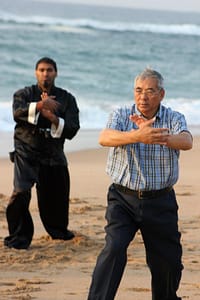
Tai Chi Chuan/Taiji Quan has become a very popular trend today, together with Yoga and Pilates, as a form of relaxation and some physical conditioning. However, the roots of Taiji remains a martial art with functional fighting applications and techniques. The spinoff is the added health (both mentally and physically) benefits that come from practicing Taiji and Qigong/Chi Kung regularly.
Today, Taiji has integrated itself into almost all Traditional Kung Fu systems. Various aspects of internal training has become a staple in the Chinese Martial Arts. These aspects have even filtered through into various other Martial Arts styles. The idea of “soft over coming hard”, has led many researchers down the path of the Internal styles and indeed fused these aspects with their own styles.

Taiji Sword
The origins of Taiji are very vague and many will argue the viewpoints and half-truths. Irrespective of who really created the concept that we NOW know as Taiji, the many stories/histories have led to today’s version on this art. One of the more believed stories is that a soldier in Tai Tzu’s army returned home to his Chen village after the war and started to teach what he had learned from his military service. The creation of the Tai Tzu style further adds some merit to this story in that Emperor Tai Tzu fused his own fighting knowledge with the knowledge gained from Shaolin’s writings/scrolls and created a new style of combat. One of the chambers of Shaolin Luohan is called Rou Quan (soft style) and shares quite alot with modern Taiji Quan.
At the senior levels all three aspects of the internal styles are taught i.e Taiji Quan, Bagua Zhang, and Xing Yi Quan.


 Shuai Jiao